It was a beautiful Tuesday in Italy, the archaeological site of Ostia Antica to be specific. As usual I had taken the trains to the site in order to study the pottery from the DAI/AAR excavations, arriving by about 9:00. The day was routine…examining the pottery the excavating team had recovered in order to provide them with dating evidence for the stratigraphic sequence. We always had lunch at a certain point in the midst of the ruins where tourists seldom arrived, beneath the umbrella pines. Then back to work in the storerooms… I would meet my 88-year old grandmother and aunt and uncle in the center of Rome in the evening for dinner, so I left the team a little earlier, around 3 p.m. I nearly fell asleep on the train home, walked to my car and started the engine. As I approached the train crossing another train was approaching, so the barrier came down. I waited in my car and was stuck by an Italian guy pacing frantically in the road speaking in an agitated manner on the phone. He seemed like a journalist, but who knows. He kept saying phrases (in Italian) like “I can’t believe this.” “It is war.” “There is a war and now what are we going to do.” I heard him mention New York. Who knows…Italians always exaggerate. I arrived home after ten minutes and started getting ready when the phone rang. It was my sister-in-law. She asked in a frantic manner (her normal tone) “Oh my god, how are your parents (in New York). Are they OK? What is happening? They dropped bombs or something.” Of course I had no clue what she was talking about so I asked her and she told me about the Twin Towers and that I should turn on the TV. I turned on the TV and like billions of other people in the world, thought “Oh my god. What the hell is happening?” It was like a dream…the images repeating over and over, the planes crashing into the Twin Towers and images of the towers collapsing. All I could do was sit on the bed and stare at the TV.
domenica 11 settembre 2011

lunedì 5 settembre 2011
Porolissum - How late is "late"?
At least two of the articles I have published begin with the word reflection.... Archaeologists reflect a lot because while some things are clear, many things are not and we ponder...this actually leads to obsession...
One of the "big" questions at Porolissum concerns the period after the Romans officially left around AD 271. Eighteen sporadic coins dating AD 325-375 have been found at the site over the years although none by the PFP. The latest coins we have found pertain to Severus Alexander (AD 222-235). Other artifacts found over the years have also been designated as "post-Roman". One of the theories is that following the Roman withdrawal from Dacia, the territory was inhabited by the Daco-Romans, namely native Dacians and Romans (perhaps veterans and their families) who presumably remained until the Huns entered Europe in the late 4th century. When we began the excavation, this was among our research questions and because so many archaeologists in Romania discuss the post-Roman phase of Dacia, I have to say that I was biased and began to "see" post-Roman artifacts. The more time I spent digging at Porolissum the more I sought evidence for the post-Roman phase, but the more I looked the less I actually saw.
The PFP has excavated a number of "late" features. In 2009 and 2010 we revealed three hearths and associated post holes, the best preserved of which was in Trench 22N. You would not expect rather crude hearths within Roman public buildings unless the original function of the buildings ceased and "squatters" were using the buildings. In addition to the hearths, we also noted that in some cases the spaces between columns in the porticus surrounding the forum's courtyard had been sealed with crude concrete masonry. With the notion of Daco-Romans in mind, we formulated a hypothesis of settlers making use of the solid architecture of the forum for houses, storage areas, workshops, etc. Afterall, the "Roman" component would have maintained technological knowledge such as the use of concrete.
With some doubts in our mind we planned the 2011, in part, to consider this question. We re-excavated Trench 22N and scrutinized all the archaeological materials we had excavated since 2004. Unfortunately there was no material situated below the "late" hearth in 22N. In reviewing the pottery, coins, etc. we realized that none can be attributed to after the 3rd century AD. There were some fragments that reminded me of 4th and 5th century AD wares from the Mediterranean, but the forms were false friends and in fact bear no relation to the Late Roman wares. Therefore, while we still do not have a firm conclusion, we are more convinced that Porolissum was not significantly inhabited after AD 271. We certainly do not have evidence for a post-Roman settlement. Instead we are considering a hypothesis that the site may have been largely abandoned and/or may have regressed prior to AD 271. Considering the rampant civil wars between rival emperors following the assassination of Severus Alexander, we wonder if troops and civilians may not have begun to move from the region. Economically, the Empire was in poor condition and while there was long distance trade in the Mediterranean, many regions were left the fend for themselves. According to this new hypothesis with a depopulation of Porolissum, say by the 240s/250s AD the last settlers may indeed have resorted to re-using public architecture for survival - hearths in the forum, closing off collanades for defense or housing, etc.
This is no to say that no human being set foot at Porolissum in the period 4th-10th centuries. In fact there is a little evidence. Only time and much study will tell.....


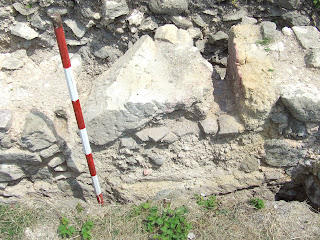
One of the "big" questions at Porolissum concerns the period after the Romans officially left around AD 271. Eighteen sporadic coins dating AD 325-375 have been found at the site over the years although none by the PFP. The latest coins we have found pertain to Severus Alexander (AD 222-235). Other artifacts found over the years have also been designated as "post-Roman". One of the theories is that following the Roman withdrawal from Dacia, the territory was inhabited by the Daco-Romans, namely native Dacians and Romans (perhaps veterans and their families) who presumably remained until the Huns entered Europe in the late 4th century. When we began the excavation, this was among our research questions and because so many archaeologists in Romania discuss the post-Roman phase of Dacia, I have to say that I was biased and began to "see" post-Roman artifacts. The more time I spent digging at Porolissum the more I sought evidence for the post-Roman phase, but the more I looked the less I actually saw.
The PFP has excavated a number of "late" features. In 2009 and 2010 we revealed three hearths and associated post holes, the best preserved of which was in Trench 22N. You would not expect rather crude hearths within Roman public buildings unless the original function of the buildings ceased and "squatters" were using the buildings. In addition to the hearths, we also noted that in some cases the spaces between columns in the porticus surrounding the forum's courtyard had been sealed with crude concrete masonry. With the notion of Daco-Romans in mind, we formulated a hypothesis of settlers making use of the solid architecture of the forum for houses, storage areas, workshops, etc. Afterall, the "Roman" component would have maintained technological knowledge such as the use of concrete.
With some doubts in our mind we planned the 2011, in part, to consider this question. We re-excavated Trench 22N and scrutinized all the archaeological materials we had excavated since 2004. Unfortunately there was no material situated below the "late" hearth in 22N. In reviewing the pottery, coins, etc. we realized that none can be attributed to after the 3rd century AD. There were some fragments that reminded me of 4th and 5th century AD wares from the Mediterranean, but the forms were false friends and in fact bear no relation to the Late Roman wares. Therefore, while we still do not have a firm conclusion, we are more convinced that Porolissum was not significantly inhabited after AD 271. We certainly do not have evidence for a post-Roman settlement. Instead we are considering a hypothesis that the site may have been largely abandoned and/or may have regressed prior to AD 271. Considering the rampant civil wars between rival emperors following the assassination of Severus Alexander, we wonder if troops and civilians may not have begun to move from the region. Economically, the Empire was in poor condition and while there was long distance trade in the Mediterranean, many regions were left the fend for themselves. According to this new hypothesis with a depopulation of Porolissum, say by the 240s/250s AD the last settlers may indeed have resorted to re-using public architecture for survival - hearths in the forum, closing off collanades for defense or housing, etc.
This is no to say that no human being set foot at Porolissum in the period 4th-10th centuries. In fact there is a little evidence. Only time and much study will tell.....


domenica 4 settembre 2011


Sterile Soil......
As the readers of this Blog know, one goal of archaeologists is to reach "Sterile Soil", namely virgin soil unaltered by man. By achieving this, archaeologists may discuss the earliest phase of occupation. In the past the PFP has reached sterile soil, but in most cases we did not reach the bottom of the trench, so to speak. Among the goals of the 2011 was to reach sterile soil, like it or not, and we did.
Trench 22N was the most satisfying. We began excavating this trench in 2010, but halted at a depth of 0.9 m when we unearthed a "late" hearth (see preliminary results of 2011 season at http://www.porolissum.org/). In 2011 we "sectioned" the hearth - literally slicing it in half - in order to verify what lay below. We found a series of very deep Roman fills with an abundance of archaeological materials. At a certain point, ca. 2.5 m in depth the materials ceased, but we encountered a thick and dense layer of charcoal-filled clay - we had reached the earliest level of the site, the timber and earth phase which dates to the time of Trajan (we even found an coin of Trajan). Since the clay was so deep and the surface of the trench so broad, we sectioned part of the trench in order to see the depth of the timber/earth layer. At a depth of ca. 3.0 m we reached virgin soil; thus we obtained the full sequence of activity in the trench.
Trench 11 was also interesting, but the students felt more like miners than archaeologists. Trench 11 holds a complex sequence of architectural features beginning with a timber/earth phase at the lowest level. Sequentially, this is followed by a massive building campaign during the reign of emperor Antoninus Pius, when a public building of unknown function was constructed. This structure was renovated on several occasions and included no fewer than 5-6 superimposed floors. The last significant building phase was in the Severan period. The layers simply continued downward, but we were determined. Finally, during the last days of the project at a depth of more than 4.0 m. we reached a layer of clay with no human-generated debris.
Trench 33, at the highest point of the site, was and is perplexing. The magnetometry results from the 1990s indicated an architectural feature. Being the highest point of the site, we fantasized about a monumental gate or a temple. In the end and after excavating about 20 cm of earth, we encountered traces of walls. After just about 10 more cm we had reached the bottom of the walls (which had been robbed in recent times by local farmers from Moigrad and Jac). There was a large building which measured at least 10 x 10 m., but it was not consistent with a public building. In fact, we speculate that this was either a house or an industrial/commercial complex (a kind of kiln was found in association with the architecture). The oddity was that seemingly sterile soil was encountered at an average of 30 cm below the modern ground level. The Romans had dug into the clay for the foundation of the building, but we did not encounter any cultural material in the clay. Just to verify, some of the students were asked to excavate to a depth of nearly 2.0 m., but they only excavated clay. A nearby trench (4) from PFP 2006 gave similar results. We wonder if this is indeed the natural clay or if it is virgin clay that had been artificially piled into a defensive mound, surrounding the original wooden feature of the Trajanic period. We will have to investigate this in future years.


Trench 22N was the most satisfying. We began excavating this trench in 2010, but halted at a depth of 0.9 m when we unearthed a "late" hearth (see preliminary results of 2011 season at http://www.porolissum.org/). In 2011 we "sectioned" the hearth - literally slicing it in half - in order to verify what lay below. We found a series of very deep Roman fills with an abundance of archaeological materials. At a certain point, ca. 2.5 m in depth the materials ceased, but we encountered a thick and dense layer of charcoal-filled clay - we had reached the earliest level of the site, the timber and earth phase which dates to the time of Trajan (we even found an coin of Trajan). Since the clay was so deep and the surface of the trench so broad, we sectioned part of the trench in order to see the depth of the timber/earth layer. At a depth of ca. 3.0 m we reached virgin soil; thus we obtained the full sequence of activity in the trench.
Trench 11 was also interesting, but the students felt more like miners than archaeologists. Trench 11 holds a complex sequence of architectural features beginning with a timber/earth phase at the lowest level. Sequentially, this is followed by a massive building campaign during the reign of emperor Antoninus Pius, when a public building of unknown function was constructed. This structure was renovated on several occasions and included no fewer than 5-6 superimposed floors. The last significant building phase was in the Severan period. The layers simply continued downward, but we were determined. Finally, during the last days of the project at a depth of more than 4.0 m. we reached a layer of clay with no human-generated debris.
Trench 33, at the highest point of the site, was and is perplexing. The magnetometry results from the 1990s indicated an architectural feature. Being the highest point of the site, we fantasized about a monumental gate or a temple. In the end and after excavating about 20 cm of earth, we encountered traces of walls. After just about 10 more cm we had reached the bottom of the walls (which had been robbed in recent times by local farmers from Moigrad and Jac). There was a large building which measured at least 10 x 10 m., but it was not consistent with a public building. In fact, we speculate that this was either a house or an industrial/commercial complex (a kind of kiln was found in association with the architecture). The oddity was that seemingly sterile soil was encountered at an average of 30 cm below the modern ground level. The Romans had dug into the clay for the foundation of the building, but we did not encounter any cultural material in the clay. Just to verify, some of the students were asked to excavate to a depth of nearly 2.0 m., but they only excavated clay. A nearby trench (4) from PFP 2006 gave similar results. We wonder if this is indeed the natural clay or if it is virgin clay that had been artificially piled into a defensive mound, surrounding the original wooden feature of the Trajanic period. We will have to investigate this in future years.


mercoledì 11 maggio 2011
Happy Birthday Constantinople!
Roma Nova Constantinopolis, better known as Constantinople, was founded on May 11, 330 AD.
The city, originally called Byzantium, has much older origins. Founded by the Greeks near the end of the 7th century BC, Byzantium was an important commercial city located at the south side of the Bosphorus, the strait which joins the Black Sea and the Aegean. We know very little about the ancient Greek city except that its acropolis was situated at the northwesternmost tip of the city; temples were dedicated to Apollo, Hera, Artemis and other divinities and there was also a theater. Byzantium entered an alliance with Rome in the later 2nd century AD but only firmly came under Romans control under Vespasian. Somewhat more is known about the city in the late 2nd century AD. During a brief period of civil war Byzantium sided with self-proclaimed emperor Pescennius Niger; unfortunately the city did not side with the victor of the civil war, Septimius Severus who punished the citizens, destroyed parts of the city, but then invested in a building campaign. At this point, new fortification walls were contructed as were an important thermal complex, the Baths of Zeuxippos. The hippodrome may have been constructed at this time or may have been reconstructed (we do not know the time of its foundation but it was certainly part of the Severan city). Byzantium was always important, but was not a metropolis like Alexandria, Carthage, Corinth or Rome.
Although we do not know the full details of the story, during a war against rival emperor Licinius, Constantine decided to monumentalize Byzantium. Thus, beginning in AD 324, Constantine invested heavily in this city. From what the limited sources tell us, he renovated many areas of the city, including the hippodrome, but also initiated massive building projects. He expanded the city four-fold with a new fortification wall; he monumentalized the main avenue, the Mese; one of the components of this new "triumphal way" was a forum (Forum of Constantine) which featured a massive porphyry column that still stands and a senate house; another monumental feature was the Milion (which indicated distances to other areas of the empire as if this city was the new umbilicus). Facing in one direction toward the Bosphorus and in the other direction onto the hippodrome, Constantine built an Imperial Palace (many scholars point out how the Imperial Palace in Rome faces onto the Circus Maximus...). One of the major components of the palace was a new church - after all Constantine was promoting Christianity - Hagia Sofia. Constantine's Hagia Sofia no longer exists, but followed a traditional basilican plan and probably resembled "old St. Peter's" in Rome (which he also commissioned). This "new Rome", Constantinople, was inauguated on May 11, 330 AD (just 20 days after the birthday of Rome on April 21....).
Scholars are still uncertain as to Constantine's intentions. Constantinople clearly became the capitial city of the late Roman Empire and the Byzantine Empire, but did Constantine intend even during his reign for this city to supercede Rome? One the one hand, Constantine invested quite heavily in Rome itself, commissioning a number of churches, the Baths of Constantine and two triumphal arches, including the famous Arch of Constantine. On the other hand, his new city had all the features of Rome - an imperial palace (that faced onto the hippodrome), a triumphal route and a forum with a senate house. We have to bear in mind that during this time in Roman history there was often more than one emperor and one of the administrative cities had been, until this time, Nicomedia, on the Asian side of the Bosphorus. Perhaps he intended to develop an imperial capital, not the new imperial capital. After his death in AD 337, an emperor would be based here and Constantinople was becoming more important than Rome (late Roman emperors when in Italy tended to reign from Milan or Ravenna). When Theodosius I assumed control of the Empire, he ruled from Constantinople. Did Constantine have the foresight to see that Rome would fall? In any event, Rome did indeed fall (in AD 476 following a period of increasing problems) and Constantinople would be the Mediterranean city during the Byzantine (until AD 1453) and Ottoman periods.


The city, originally called Byzantium, has much older origins. Founded by the Greeks near the end of the 7th century BC, Byzantium was an important commercial city located at the south side of the Bosphorus, the strait which joins the Black Sea and the Aegean. We know very little about the ancient Greek city except that its acropolis was situated at the northwesternmost tip of the city; temples were dedicated to Apollo, Hera, Artemis and other divinities and there was also a theater. Byzantium entered an alliance with Rome in the later 2nd century AD but only firmly came under Romans control under Vespasian. Somewhat more is known about the city in the late 2nd century AD. During a brief period of civil war Byzantium sided with self-proclaimed emperor Pescennius Niger; unfortunately the city did not side with the victor of the civil war, Septimius Severus who punished the citizens, destroyed parts of the city, but then invested in a building campaign. At this point, new fortification walls were contructed as were an important thermal complex, the Baths of Zeuxippos. The hippodrome may have been constructed at this time or may have been reconstructed (we do not know the time of its foundation but it was certainly part of the Severan city). Byzantium was always important, but was not a metropolis like Alexandria, Carthage, Corinth or Rome.
Although we do not know the full details of the story, during a war against rival emperor Licinius, Constantine decided to monumentalize Byzantium. Thus, beginning in AD 324, Constantine invested heavily in this city. From what the limited sources tell us, he renovated many areas of the city, including the hippodrome, but also initiated massive building projects. He expanded the city four-fold with a new fortification wall; he monumentalized the main avenue, the Mese; one of the components of this new "triumphal way" was a forum (Forum of Constantine) which featured a massive porphyry column that still stands and a senate house; another monumental feature was the Milion (which indicated distances to other areas of the empire as if this city was the new umbilicus). Facing in one direction toward the Bosphorus and in the other direction onto the hippodrome, Constantine built an Imperial Palace (many scholars point out how the Imperial Palace in Rome faces onto the Circus Maximus...). One of the major components of the palace was a new church - after all Constantine was promoting Christianity - Hagia Sofia. Constantine's Hagia Sofia no longer exists, but followed a traditional basilican plan and probably resembled "old St. Peter's" in Rome (which he also commissioned). This "new Rome", Constantinople, was inauguated on May 11, 330 AD (just 20 days after the birthday of Rome on April 21....).
Scholars are still uncertain as to Constantine's intentions. Constantinople clearly became the capitial city of the late Roman Empire and the Byzantine Empire, but did Constantine intend even during his reign for this city to supercede Rome? One the one hand, Constantine invested quite heavily in Rome itself, commissioning a number of churches, the Baths of Constantine and two triumphal arches, including the famous Arch of Constantine. On the other hand, his new city had all the features of Rome - an imperial palace (that faced onto the hippodrome), a triumphal route and a forum with a senate house. We have to bear in mind that during this time in Roman history there was often more than one emperor and one of the administrative cities had been, until this time, Nicomedia, on the Asian side of the Bosphorus. Perhaps he intended to develop an imperial capital, not the new imperial capital. After his death in AD 337, an emperor would be based here and Constantinople was becoming more important than Rome (late Roman emperors when in Italy tended to reign from Milan or Ravenna). When Theodosius I assumed control of the Empire, he ruled from Constantinople. Did Constantine have the foresight to see that Rome would fall? In any event, Rome did indeed fall (in AD 476 following a period of increasing problems) and Constantinople would be the Mediterranean city during the Byzantine (until AD 1453) and Ottoman periods.


sabato 23 aprile 2011
Lewis Binford
Lewis Binford, Professor of Archaeology, passed away on April 11, 2011. I am not sure how well-known Prof. Binford is amongst the latest generation of Classical Archaeologists, but his work had a very strong impact on my development. I was first introduced to his work as a Freshman at the University of Albany, SUNY in a course “Introduction to Archaeology” and was immediately turned onto the premise that we should not simply recover and describe artifacts but we need to “interrogate” archaeological features and assemblages according to a scientific method in order to draw conclusions about human cultures. This all seems self-evident today, but when he developed his theories and, in fact, a new school of archaeology in the 1960s and 70s (called, New Archeology or Processual Archaeology), he was a revolutionary. He was not the first or last to write archaeological theory, but he certainly made archaeological theory a more important part of scholarship.
Binford was an undergraduate and graduate student at a time when archaeology was in transition. The age of Antiquarianism was on the wane as more and more scholars began to pay attention to all details of archaeological projects: careful stratigraphic excavation techniques, proper recording of trenches, features and finds, analysis of all archaeological objects. Conclusions were broadening out from descriptions of this or that building or object to discussions of “cultures”. Archaeologists used seriation to study the development of artifact assemblages and features over time; they were discussing cultural change and influence. There were also background debates about the discipline of archaeology – normally viewed as a “fun” tool for answering “higher level” anthropological or historical questions.
As he matured, Binford sought to do more and to put the discipline of Archaeology on the map. Some of his key articles are “Archaeology as Anthropology” (1962), “Archaeological Systematics and the Study of Culture Process” (1965), and “Some Comments on Historical versus Processual Archaeology” (1968). It was also in 1968 that he edited a volume with his wife Sally Binford “New Perspectives in Archeology,” the result of a conference he organized in order to demonstrate the state of the discipline. Through these and later works, he developed his ideas and I will describe the basic tenets.
Perhaps the two greatest ambitions of the New Archeology were to elucidate cultural systems and processes and to study the statics and dynamics of human cultures. Drawing from systems theory and structuralism, Binford proposed that archaeological materials can be studied in order to reveal information regarding cultural systems and sub-systems (e.g., social organization, religion, science, technology, art). Any sub-system of a given culture can affect or be affected by other sub-systems, which can lead to small or significant cultural change. Binford argued that archaeological materials can be used to effectively study non-material aspects of culture.
Linked to this, Binford sought to investigate the statics and dynamics of cultures: archaeology is the study of “static” objects and features which can reveal important information regarding the dynamics of society. For example, the examination of a stone tool (type of stone, shape, technique) can reveal technological innovations, function and so forth. Comparisons of stone tools from different times may lead to understandings in change (not only that we see type X first and then type Y). We can ask questions such as who made the tool and how? Why this particular stone quality and/or shape? What affected change in stone quality and/or shape from X to Y – greater efficiency? response to environmental change? religion? influence from another culture? “Processual change in one variable can then be shown to relate in a predictable and quantifiable way to changes in other variables, the latter changing in turn relative to changes in the structure of the system as a whole. This approach to explanation presupposes concern with process, or the operation and structural modification of systems” (Binford 1962, 217).
In order to achieve this, Binford proposed adhesion to the scientific method of beginning with explicit aims, establishing and following an approach, gathering evidence, testing hypothesis; if hypothesis is correct, it joins body of reliable knowledge upon which new hypotheses can be based, if not the researcher develops a new hypothesis to be tested. Archaeological excavation should be conducted scientifically to obtain solid data – attention to strata, recovering and documenting all features and artifacts. Computer analyses were now available as were early archaeometric techniques such as Carbon 14 dating. Because Binford was a prehistorian, his evidence was quite scarce (unlike classical archaeologists who have far more material evidence); therefore, Binford relied strongly upon ethnographic analogy. He stressed that while the study of living cultures could help interpret archaeological scenarios, he was cautious, indicating that careful testing and comparison had to be conducted and that similarities between ancient and modern patterns might not explain the past.
Binford clearly had his critics and it is amusing to read articles of his critics and his responses. One of his earliest critics, Walter W. Taylor, essentially stated in a review of “New Perspectives in Archeology” that Binford and his colleagues were not really doing anything new despite statements that they were moving away from “traditional archaeology”; Taylor wrote that the “New Archeologists” were re-hashing in a dramatic way archaeological theory which had been developed 20 years prior. One major critique was of Binford’s “covering laws”. Earlier in his career Binford maintained that human culture developed in a more or less parallel manner regardless of time and space; he set out to establish general covering laws that could explain any archaeological situation.
Binford clearly developed many ideas which archaeologists can agree with or not; most importantly he was an extremely vocal advocate of archaeological theory. Archaeologists must really set out to think about their data; they should not be content with description. In order to draw important “cultural” conclusions from a set of data, one needs to develop serious questions and approaches and must examine data in the context of the questions and approaches. Indeed, know it or not, most contemporary archaeologists follow his essential model.
When I was writing my PhD dissertation on Roman pottery, I read a lot of archaeological theory; I even co-organized a conference in Rome called “Archaeological Methods and Approaches.” At some point, I decided to write a fan letter to Prof. Binford….and he responded! He wrote that he was pleased to hear that classical archaeologists were reading his (and others’) work and were keeping a pulse on archaeological theory. He was one of the Greats - so read some of his work!
sabato 26 febbraio 2011
February 27 - Happy birthday, Constantine
Flavius Valerius Aurelius Constantinus, better known as Constantine the Great, ruled the Roman Empire for 31 years, AD 306-337. He was the son of Constantius Chlorus and St. Helena (known for having discovered the True Cross in the Holy Land). Following his father’s death, Constantine obtained the emperorship in AD 306, serving with Maxentius, Maximinus Daia and Licinius. Civil War broke out and, with the battle of the Milvian Bridge in AD 312, Constantine and Licinius were the victors.


A champion of Christianity, Constantine legalized the religion the following year with the Edict of Milan and sponsored the construction of many churches in Rome and the Empire, including “Old Saint Peter’s”. Among his other architectural achievements in Rome are the Arch of Constantine and the Baths of Constantine, located on the Quirinal Hill. After co-ruling the Empire for 12 years, Constantine defeated Licinius in a war in AD 324 in Asia Minor. A year later, he oversaw the Council of Nicea, where the fundamentals of Catholicism as we know it were developed. It was also at this time that the Emperor decided to build a new city. Located on the Bosphorus, the Emperor monumentalized the existing city of Byzantium, but changed the name to Nova Roma in time for its inauguration on May 11, 330 AD. Constantine died in May 337 AD and was buried in “New Rome”, better known as Constantinople, a capital city that would endure for nearly 1000 years after the original Rome fell.
Upcoming Conference on the Severus Dynasty
Dept. Art History and Studio Arts and Dept. of Humanities,
John Cabot University
Presents
The Roman Empire during the Severan Dynasty
Conference Organizer: Eric C. De Sena
Scientific Committee:
Benedetta Bessi
Thomas Govero
Jens Koehler
Luca Larpi
John Cabot University, April 15-16, 2011
Friday, April 15, 2011, (Tiber Campus, JCU) 9:00-19:30
9:00-9:15 Introduction by Eric C. De Sena
Session I – Roman Provinces during the Severan Period
9:15-9:35 Simone Rambaldi (Università degli Studi di Bologna/ Facoltà di Conservazione dei Beni Culturali, Trapani). L’attività edilizia romana a destinazione pubblica fra i Severi e i Soldatenkaiser: trasformazioni e continuità.
9:35-9:55 Jean-Paul Petit (Parc Archeologique europeen de Bliesbruck-Reinheim) and Sara Santoro (Università degli Studi di Chieti). Lo sviluppo del vicus Bliesbruck (Moselle, France) agli inizi del III sec. d.C. e la vitalità della Gallia Belgica mosellana nell’epoca dei Severi.
9:55-10:15 Alice Dazzi (Università degli Studi di Parma). Water works and monuments in the Severan Age: some considerations.
10:15-10:30 Giovanni Distefano, "Cartagine durante l'età Severiana".
10:30-10:50 Discussion
Coffee Break 10:50-11:10
11:10-11:30 Tino Lelekovic (Croatian Academy of Sciences and Arts). Southern Pannonia in the time of the Severans.
11:30-11:50 Mujde Turkmen (Istanbul University). Architectural decoration of the Severan period in Pamphylia and Cilicia.
11:50-12:10 Giancarlo Germanà (Accademia di Belle Arti di Siracusa). Some observations on Sicily during the Severan Dynasty.
12:10-12:30 Daniele Malfitana (CNR – Università di Catania). Economy of Sicily during the Severan Period.
12:30-12:50 Discussion
Lunch Break 12:50-13:40
Session II – Aspects of the Economy during the Severan Period
13:40-14:00 Edoardo Radaelli (Sapienza- Università di Roma). Analisi di un riempimento fognario di età severiana dalle cosiddette “Terme di Elagabalo” a Roma.
14:00-14:20 Eszter Harsanyi (affiliation). La ceramica a vernice nera di Treviri: un prodotto di lusso nella Pannonia durante l’epoca severiana.
14:20-14:40 Viorica Rusu-Bolindet (affiliation). Supply and consumption of Samian ware in Romania Dacia during the Severan period.
14:40-15:00 Lucia Afonso (University of Buffalo, SUNY). Is there a Relationship between the Decreasing of Senators from the Iberia Peninsula and the Liberation of the Production and sale of Baetican oil for the annona during the Severan Dynasty?
15:00-15:20 José Carlos Quaresma (University of Lisbon). Economic growth in the early and middle Imperial periods, pre-200 AD: an economic approach from a peripheral province, Lusitania.
15:20-15:40 Discussion
Coffee Break 15:40-16:00
Session III – Severan History and Literature
16:00-16:20 Ivo Topalilov (University of Shumen, Bulgaria). The origo of the Thracian Praetorians in the time of Severi.
16:20-16:40 Mark Gradoni (Hood College). Parthian Campaigns of the Severan Emperors: Imperial Policy and Parthian Military Potency, 193-224 CE.
16:40-17:00 Thomas Govero (John Cabot University). Legal reforms of Ulpian.
17:00-17:20 Erik Thadeus Walters (John Cabot University). Unitas ex Africa: were Tertullian and Cyprian of Carthage unwitting architects of both Imperial and Church unification?
17:20-17:40 Adam Kemezis (University of Alberta). The Severan Sophistic? Dynastic change and continuity in Philostratus.
17:40-18:00 Discussion
Reception 18:00-19:30 – Refreshments and entertainment by the “Ninfe Dacie”
Saturday, April 16, 2011 (Location: Aula Magna, JCU)
Session IV – Severan Art, Architecture and Ideology – need to re-do this schedule
10:00-10:20 Florian Leitmir (Staatliche Antikensammlungen und Glyptothek, Munich). Between tradition and innovation: the visual representation of Severan Emperors.
10:20-10:40 Stephan Faust (University of Hamburg). Ideological messages and local preferences: the imagery of the Severan Arch at Lepcis Magna.
10:40-11:00 Andrea Gariboldi (affiliation). Elagabalo invictus sacerdos: l’imperatore fanciullo e la centralizzazione del sacro attraverso lo specchio delle monete.
11:00-11:20 Luigi Pedroni (affiliation). Athena/Brigantia on an aureus of Septimius Severus.
11:20-11:40 Paola Puppo (affiliation). Vestigia architettoniche del periodo di Settimio Severo in Tunisia.
11:40-12:00 Discussion
Lunch 12:00-12:50
12:50-13:10 Guido Petruccioli (Oxford University). Dynastic commemoration in metropolitan and provincial honorific statuary of the Severans.
13:10-13:30 Maria Lloyd (University of Reading). The Arch of Septimius Severus in the Roman forum: a re-consideration.
13:30-13:50 Jens Koehler (John Cabot University). More water for Rome: nothing new in the Eternal City? Aqueducts, fountains and baths of the Severan Emperors.
13:50-14:10 Ottavio Bucarelli (Ponteficia Università Gregoriana). Il c.d. tempio di Serapide sul Quirinale. Topografia e archeologia dall’antichità al medioevo.
14:10-14:30 Flavia Guardascione (Università di Napoli Federico II). L’eredità dei Severi: architetture monumentali da Baiae
14:30-14:50 Discussion
14:50-15:00 CONCLUSIONS
mercoledì 15 dicembre 2010
Flood in Zalau
Last June in the midst of some of the worst weather Europe has experienced, the city of Zalau was flooded. There are news reports and YouTube videos of this disaster. Fortunately no one was injured, although there was about a meter of water at ground level. People with basements got flooded, including the Salaj County Museum of History and Art. The Museum has two primary storage areas - one above ground and one in a large basement. There had never been any problems until June 2010...
All of the artifacts stored in the basement were soiled and the Museum workers together with local volunteers, including members of the PFP Team, spent about a month washing, re-labeling and re-storing all of the artifacts. Despite the obvious difficulties, it was indeed a moment when everyone came together to help. This is the unfortunate state of cultural institutes in Romania - hardly any funding to perform an incredible mission - to investigate, document, preserve, and share the Past.
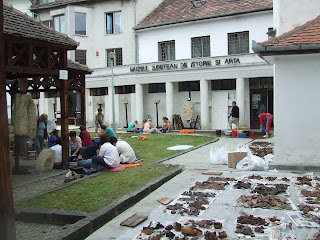


All of the artifacts stored in the basement were soiled and the Museum workers together with local volunteers, including members of the PFP Team, spent about a month washing, re-labeling and re-storing all of the artifacts. Despite the obvious difficulties, it was indeed a moment when everyone came together to help. This is the unfortunate state of cultural institutes in Romania - hardly any funding to perform an incredible mission - to investigate, document, preserve, and share the Past.


Excavators' best profile pictues???
I have spent the entire day manipulating an Excel spreadsheet full of pottery data from the Danish Academy's Nomentum Forum Project (do I detect a trend in the projects with which I am affiliated?). This is a very interesting project which is exploring the forum of the small town of Nomentum in Rome's hinterland - preliminary pottery report due these days. As an escape, this new blog post...
When you are taking on-site photographs, it is difficult to take flattering pictures of people unless you actually ask them to pose in a certain manner and pretend to excavate. While people are working, they tend to be in various awkward positions and while you try to take the best action shots of a trench, you inevitably photograph people from behind... In a goofy moment last summer (or several goofy moments) I took intentional portraits of people where the sun doesn't usually shine.


When you are taking on-site photographs, it is difficult to take flattering pictures of people unless you actually ask them to pose in a certain manner and pretend to excavate. While people are working, they tend to be in various awkward positions and while you try to take the best action shots of a trench, you inevitably photograph people from behind... In a goofy moment last summer (or several goofy moments) I took intentional portraits of people where the sun doesn't usually shine.


mercoledì 8 dicembre 2010
Stilicho: Virtuous Vandal, Defender of Rome
This the introduction of an article I wrote recently about a Late Roman commander, Flavius Stilicho. Stilicho was ethnically a Vandal, but he gained the trust of Emperor Theodosius and ultimately ruled the western part of the Roman Empire for 12 years. Quite an intriguing personality. The article has been published in the memorial volume dedicated to Alexandru Matei (Horea Pop and Dan Bacuet-Crisan, editors).
“He commanded all nations looked on by the rising and setting sun” (Claudian CS I, 160-161).
I. Introduction. Late Antiquity represents one of the most complex moments in Roman history. The period between the late Severan period and the so-called fall of the Western Roman Empire witnessed a considerable amount of social, political, and military upheaval: Romans fought other Romans; Romans fought “barbarians”;[1] “barbarian” groups fought other “barbarian” groups to defend themselves or to assist Rome; Christians waged war on Paganism and amongst themselves; and so forth. This period, however, is perhaps best characterized as a time marked by existential crisis and transition. Following a long period of stability between Augustus and Septimius Severus, the inhabitants of the Roman Empire began to lose a sense of what “Rome” stood for.
Students of Roman history are well aware that the “Rome” of Late Antiquity was not the same “Rome” during the Age of Augustus. The Roman Empire was already an ethnic melting pot by the mid 2nd century AD and by the 3rd century the Army had essentially equaled or superseded the Senatus Popolusque Romanus as the chief political institution. Even prior to Caracalla’s decree in AD 212 granting citizenship to most free-born people residing within the confines of the Empire, “Romans” were ethnically German, Spanish, Libyan, Syrian, Thracian, etc. as well as Italian. By the 3rd century, the Empire began to fragment for both positive and negative reasons and Diocletian formed the Tetrarchy to counter the increasing dissent and dissolution. Despite a good concept, the Tetrarchy was not effective for very long and, coupled with the treachery and infighting that began in the 3rd century, actually prompted the net division between West and East.
There were changes beyond the European borders of the Roman Empire as well. Following a relative peace between the Romans and native European groups in the 1st and 2nd centuries, the “barbarians” began to take advantage of the Romans’ inner struggles, putting pressure on the borders and eventually claiming pieces of the Empire. Some cultures were more hostile than others, whilst some groups became allies of Rome and even helped Rome fend off the incursions of other “barbarian” groups. Many “barbarians” joined the Roman army and learned the benefits of Roman civilization; many native elites developed amicable relationships with high-ranking Roman officials, including the Emperor. This is the context we need to bear in mind when considering the deeds and character of Stilicho, an ethnic Vandal who appears to have had a clear understanding of what “Rome” signified and what values a Roman man should follow.[2]
Ethnic and 'National' Identity in ancient Rome
This is an excerpt (Conclusion) from an article that will be published soon in a volume I edited with colleague Halina Dobrzanska: E.C. De Sena and H. Dobrzanska (eds.), The Roman Empire and Beyond: Archaeological and Historical Research on the Romans and Native Cultures in Central Europe, BAR-IS (in preparation). The article is entitled "Through the Looking Glass: perceptions of ethnic and national identity in the Roman Balkans and beyond."
V. Conclusion. This paper has explored the issue of how the natives of the Roman Balkans and beyond were perceived by core Romans and how they viewed themselves in terms of ethnic and national identity. The first analysis, based primarily upon public art in Rome and the writings of Ovid and Tacitus, suggest that perceptions of the central European natives changed over time from being considered as subjects or curious savages in the Augustan Age to dignified adversaries during the reign of Trajan. At the time of Hadrian and Antoninus Pius, the natives were clearly portrayed as diverse from core Romans, but were considered to be an integral part of the Empire. A similar attitude of Rome as an ethnic melting pot was maintained into the reign of Marcus Aurelius; however, the Marcomannic-Sarmatian Wars fed attitudes of hostility toward the “barbarians” beyond the Roman limes. Auxiliary troops, who represented civilized natives, are more prominent in official art at this time, indicating an attitude of acceptance of Rome’s multi-ethnic population. Clearly, public art does not provide such keen insights into how the entire population of the Urbs and Italy perceived the natives of the Balkans. The works of art reflect the attitude of the patrons and, while these media would have been reinforced by triumphal processions, public addresses and spectacles or literature, we cannot be sure how deeply accepted the messages were by the general populace. Passers-by may not have so much as glanced at the Columns and Triumphal monuments as they led their lives in Rome, let alone stopping and pondering over the figures.
The natives of the Roman Balkans and the adjacent area of Barbaricum (i.e., Hungary, Slovakia, Poland and Romania) also perceived themselves in a small variety of manners. Many native elites and other socially ambitious inhabitants of the provinces displayed Roman attributes in terms of appearance and behavior, which is discerned by a review of portraiture and, to some degree, housing. Togas and Antonine beards could not mask all ethnic features and some natives chose to wear ethnically characteristic items of clothing or adornment. Most natives both within and outside the Empire were not interested in becoming Roman and continued their traditional practices of craft production, agriculture and forms of housing. This is not readily apparent in the archaeological record of the Empire with the exception of some pottery types. A review of artifact assemblages and settlement patterns in Barbaricum, however, even at sites in close proximity of Aquincum and Porolissum, indicates that the native populations only adopted minor attributes or techniques from the Romans insofar as they could obtain modest economic benefits.
The Roman Empire was miraculous in terms of the extent, solidity and duration of its existence. What began as an oligarchic republic that controlled the western and central Mediterranean basin developed into a highly democratic and ethnically diversified state. The Romans would always seek to maintain their system of values (e.g., justice, valor, piety, self-sufficiency); however, in the Republican and early Imperial periods Romans were ethnically Italian and there was a great distinction between citizens and non-citizen natives. By the Severan period “Roman” no longer implied Italian origin and, in fact, much of the Late Roman ruling class hailed from all corners of the Empire. Even common folk must have felt a deep connection to Roman tradition and culture after two or three centuries of Roman rule. People were often proud of their homelands and, thus, maintained, their ethnic attributes, including names, clothing, items of adornment, local gods, etc. Like the vines on the Ara Pacis, these diverse groups formed the Empire. Indeed this is one of the chief factors that led to the greatness of Rome: common vision and attitudes, while accepting diversity and change.
martedì 7 dicembre 2010
Remembering John Lennon
While I am on the subject of remembering people who are no longer with us (physically), I just wanted to say a few words about John Lennon who was killed thirty years ago on Dec. 8, 1980. There are billions of Beatles and J.L. fans out there, so what more can I say?
Music has always been an important part of my life. The Beatles were the first group I was introduced to at the tender age of 6 or 7 by my Mom. I was immediately obsessed and drove all of my relatives and friends crazy as I listened to their music over and over and over and over. I started playing guitar on my 12th birthday and of course what else would I play? By this age (OK, I will admit I was 12 years old in 1980....), John Lennon was clearly my favorite and I had also begun listening to his solo albums. I remember the morning of Dec. 9 when I heard the news. My dad was out of town those days and sometime in the early morning I climbed into my parents' bed. My mom had turned on the TV and there were images of the Beatles on every channel. Not realizing at first why, we soon learned. It was a school day and there was a small group of youngish musician friends who mourned...
His music and lyrics were all pretty simple, but the messages: "Instant Karma's gonna get you...", "Love is you, you and me...", "Trying to shovel smoke with a pitchfork in the wind...", "People say I'm crazy; dreaming my life away...", "Life is what happens to you while you're busy making other plans..." I really do not listen to his music often anymore, but when I play guitar his songs are always with me...and of course Oct. 9 and Dec. 8 are like religious holidays for me.
Music has always been an important part of my life. The Beatles were the first group I was introduced to at the tender age of 6 or 7 by my Mom. I was immediately obsessed and drove all of my relatives and friends crazy as I listened to their music over and over and over and over. I started playing guitar on my 12th birthday and of course what else would I play? By this age (OK, I will admit I was 12 years old in 1980....), John Lennon was clearly my favorite and I had also begun listening to his solo albums. I remember the morning of Dec. 9 when I heard the news. My dad was out of town those days and sometime in the early morning I climbed into my parents' bed. My mom had turned on the TV and there were images of the Beatles on every channel. Not realizing at first why, we soon learned. It was a school day and there was a small group of youngish musician friends who mourned...
His music and lyrics were all pretty simple, but the messages: "Instant Karma's gonna get you...", "Love is you, you and me...", "Trying to shovel smoke with a pitchfork in the wind...", "People say I'm crazy; dreaming my life away...", "Life is what happens to you while you're busy making other plans..." I really do not listen to his music often anymore, but when I play guitar his songs are always with me...and of course Oct. 9 and Dec. 8 are like religious holidays for me.
Remembering Alexandru Matei
This is an excerpt from the PFP website regarding the passing of our Friend and Colleague, Alexandru Matei:


Just one month after the conclusion of the field season we experienced a tremendous loss. On Sept. 4, the founder of the Forum Project, Alexandru Matei passed away. He is one of the greatest men I have known and we will carry on the Project in his honor. I met Alexandru in 2002 at a conference I co-organized with the Mellon Professor of the American Academy in Rome, Prof. Archer Martin. Shortly thereafter, we were contacted by Alexandru regarding the possibility of a collaboration. I was very interested and visited Porolissum in Fall 2003 - I saw the great potential of the Project. We organized a pilot student with just 3 field school students in 2004 and then started the major campaigns in 2006. I was already an experienced archaeologist, but he taught me and my colleagues much more. He loved life and had a great spirit - he shared all of his experiences with the core staff and students. He told us stories of his excavations, about how his love for Porolissum and Salaj County drove him to develop the Museum and historical sites throughout the county. He led us on the field trips and gave us insights into the entire history of his beloved Romania, including the fact that he was a local revolutionary in Zalau in the overthrow of the dictatorship in 1989. He fought many battles on the archaeological front, driven by his passions to revolutionize the archaeological and historical scene in Romania. He was the greatest Leader I have ever met, reminding me of figures such as Gaius Marius or Julius Caesar. He brought people together, was always the focal point, he was a hard worker and expected everyone around him to work hard. He also liked to play and was the life of dinners and social affairs. He was loved by all of his closest students and colleagues who understood his loving and somewhat rebellious spirit. He enjoyed summer 2010 tremendously - I saw him always happy. We organized a festival at Porolissum on August 1 - Romano-Dacian Day which involved re-enactments of battles, traditional dances and, of course, Roman food and drink (there are many pictures on Facebook). The last time I saw him, just 4 days before his passing, we had pizza at a table set under the night sky at the highest point of Porolissum (Alexandru, Zsolt, Rob, Ancuta and myself). His favorite phrase was simple: "Life is good!". Indeed it was and is...


Just one month after the conclusion of the field season we experienced a tremendous loss. On Sept. 4, the founder of the Forum Project, Alexandru Matei passed away. He is one of the greatest men I have known and we will carry on the Project in his honor. I met Alexandru in 2002 at a conference I co-organized with the Mellon Professor of the American Academy in Rome, Prof. Archer Martin. Shortly thereafter, we were contacted by Alexandru regarding the possibility of a collaboration. I was very interested and visited Porolissum in Fall 2003 - I saw the great potential of the Project. We organized a pilot student with just 3 field school students in 2004 and then started the major campaigns in 2006. I was already an experienced archaeologist, but he taught me and my colleagues much more. He loved life and had a great spirit - he shared all of his experiences with the core staff and students. He told us stories of his excavations, about how his love for Porolissum and Salaj County drove him to develop the Museum and historical sites throughout the county. He led us on the field trips and gave us insights into the entire history of his beloved Romania, including the fact that he was a local revolutionary in Zalau in the overthrow of the dictatorship in 1989. He fought many battles on the archaeological front, driven by his passions to revolutionize the archaeological and historical scene in Romania. He was the greatest Leader I have ever met, reminding me of figures such as Gaius Marius or Julius Caesar. He brought people together, was always the focal point, he was a hard worker and expected everyone around him to work hard. He also liked to play and was the life of dinners and social affairs. He was loved by all of his closest students and colleagues who understood his loving and somewhat rebellious spirit. He enjoyed summer 2010 tremendously - I saw him always happy. We organized a festival at Porolissum on August 1 - Romano-Dacian Day which involved re-enactments of battles, traditional dances and, of course, Roman food and drink (there are many pictures on Facebook). The last time I saw him, just 4 days before his passing, we had pizza at a table set under the night sky at the highest point of Porolissum (Alexandru, Zsolt, Rob, Ancuta and myself). His favorite phrase was simple: "Life is good!". Indeed it was and is...
New Romania Blog
Too many passwords to remember... I forgot the password of the first blog over the summer and am beginning a new "Experiencing Romania" blog, which is primarily surrounding the Porolissum Forum Project excavations (http://www.porolissum.org/), but not only. Apologies for the discontinuity...
Iscriviti a:
Post (Atom)